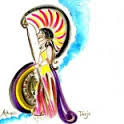
Prompt: The Stadium

The stadium was bright and empty, but in a few hours, I knew it would be something special.

It wasn’t the kind of special that came with roaring crowds and foam fingers or the thunder of a championship game. No, this was a quieter special. Stranger. Tender in the way only history can be tender when we remember the good things that happened.

The seats, patterned in reds and blues and yellows, like a mosaic of sunlight on water, waited patiently beneath the open sky. Two dark screens hung above the pitch like closed eyelids, resting before the moment of waking and flickering open. The grass was trimmed, manicured even, with ceremonial care, the centre circle perfectly drawn, as if the planet itself was holding its breath.

In the middle of that circle, engineers had placed a landing mark; subtle, silver, almost delicate. A starship did not need a stadium, not really. But we did. Because we wanted somewhere big enough for gratitude.

They were coming back today.

The first children to leave Earth. The brave, impossible dreamers who boarded colony ships with raucous laughter in their mouths and silent fear tucked behind their ribs. They went to a planet so far away that time stretched thin between here and there. They built cities under an alien sun. They planted gardens in strange soil. They raised families in domes of glass and hope.

And now… now they were returning as grandparents.

Not because they wanted to. But because their grandchildren had decided they were no longer useful. The colony had become efficient, modern, sharp-edged. There was no room for slow hands or old stories. The elders were shipped away like outdated equipment, their heroism archived, their bodies inconvenient. So they were sent back to the cradle of humanity.

To Earth. To us. To this stadium.

We had prepared apartments for them, small and bright, with soft beds and warm kitchens and windows that looked out onto parks instead of endless red dust. “All mod cons,” the mayor kept saying, as if comfort could patch the wound of exile. As if you could furnish away rejection.

But we could do something else. We could welcome them.

By noon, the stands filled… not with sports fans, but with families holding banners painted in careful, childish letters: THANK YOU. WELCOME HOME. HEROES.

The air shimmered with anticipation. Somewhere, a choir and a band did their dress rehearsal. Many old people clutched photos of their siblings, who had left fifty years ago.

Then, at last, the sky changed.

A shadow passed over the stadium, and every face tilted upward. The starship descended like a slow miracle, engines humming low, almost respectful. It settled onto the grass with a sigh of displaced air.

For a moment, there was silence. Then the doors opened.

And the heroes stepped out; wrinkled, silver-haired, smaller than the legends we had made of them, but carrying the weight of worlds in their posture.

The stadium erupted. Not in noise for a game. But in joy for a homecoming.

In reverence for those who had once been children brave enough to colonise the stars… and who deserved, finally, to be held close again.

The Runner – Prompt

There must be a metaphor somewhere in the image of a runner in the snow, but I couldn’t think of it.

So I will stick to the truth, and nothing but the unvarnished truth.

He runs because running is the only way his thoughts behave. They line up, fall into rhythm, stop nagging and shouting. Snow needles his face, the kind of cold that wakes the blood. His breath ghosts ahead of him like something trying to escape him. He tells himself this is about fitness, about lungs, and legs, and the slow redemption of a body neglected by grief and convenience. He tells himself a lot of things while running.

The road is empty except for him and the snow and the future, which always feels just out of reach, thinning the air. He is late, he knows that too, but lateness has become a permanent condition, like a limp. He does not even know what he is late for; perhaps to expectations, to anger, to himself. Running is his apology, his bandage.

When the church comes into view, it arrives without warning, crouched at the edge of the road like a thought he’s been avoiding. Cars line the street. People stand in small, tight knots, dark coats buttoned up to their throats, faces turned inward. A funeral. He slows, irritation flickering… the road will be blocked, of course it will. People will look at him. And then he sees them properly.

Names surface before faces do. His sister’s posture. His old neighbour’s hat. The way his uncle still stands as if bracing for bad news, even when the worst has already happened. He stops running.

Snow keeps falling. It does not care.

They see him then. One by one, like dominos tipped by disbelief. A mouth opens. A hand flies up, as if to shield the eyes from a trick of light. Someone whispers his name, not loudly, but urgently, the way you speak to ghosts in case they spook.

The coffin is closed, polished, unbearably solid. It contains a version of him… paperwork, certainty, a mistake made official. He understands it all at once, with the calm that comes when shock burns through confusion and leaves clarity behind. The car. The cabin. The borrowed keys. His friend, who needed the car more than he did, who had laughed and said, “You’re a hermit now, anyway.”

He had gone to the woods to disappear gently. To get fit. To breathe without witnesses. To become lighter, maybe enough to forgive himself for surviving things other people didn’t. He hadn’t meant to vanish like this.

Someone is crying now. Someone else is laughing; a short, hysterical sound that snaps in the cold. He doesn’t step forward immediately. He feels like an interruption, like a footnote that refuses to stay at the bottom of the page.

Running brought him here, but it didn’t prepare him for this: the knowledge that you can be mourned honestly, loved fiercely, and still be completely wrong about who you are to the world. He was loved. He was missed.

Eventually, he lifts a hand. Proof of life is a small thing. Just skin and bone and heat. But it’s enough.

Tomorrow, he will run again. Not away. Not late. Just forward.

The Snowman – Prompt

He appeared on a night when the snow finally got it right.

Not the thin, apologetic flakes that vanish on contact, not the dry powder that squeaks beneath boots and refuses to cling to itself… but the heavy, breathing kind. Four inches at least. Wet. Willing. The sort of snow experts talk about with authority, the sort that knows how to hold a shape.

No one saw him being made.

One evening the park was empty except for the trees, their branches stitched with frost, and the amber streetlights humming softly to themselves. The next morning, there he was. A snowman standing just off the path, slightly crooked, twig arms spread as if he’d been interrupted mid-sentence. Coal buttons. Carrot nose. A round head tilted in thought. He looked less like a decoration and more like a decision.

People stopped.

They took pictures. They circled him, looking for footprints, for evidence of hands, gloves, a trail of intention. There was nothing. The snow around him was smooth, untouched, as though he had risen straight out of the ground.

“Who made you?” someone asked, half-joking, half-uneasy.

“I did,” the snowman said pleasantly.

Phones dropped. Someone laughed too loudly. Another person swore.

“I mean,” the snowman added, “the snow did most of the work.”

He could hear them, he explained. Sound travelled strangely through snow… muted but intimate, like a secret pressed into the ear of the world. He had been listening long before anyone noticed him. Listening to boots crunch, to distant traffic, to the soft complaints of winter.

Children approached first. They always did. They asked him questions that mattered.

“Do you melt?”

“Yes.”

“Are you cold?”

“No.”

“Do you know Santa?”

“I know of him,” the snowman said. “We move in similar seasons.”

Adults came closer once the fear loosened its grip. Someone whispered that there had to be a speaker inside him. A prank. An art installation. A radio buried in his belly.

“That would explain it,” a man said, relieved.

“Would it?” the snowman replied.

They argued quietly, as if he couldn’t hear. Someone tapped his side. Another knocked harder, listening for the hollow truth of machinery. The snowman stayed still, smiling with the patience of something that had nowhere else to be.

To pass the time, he told jokes.

“What do you get when you cross a vampire and a snowman?” he asked.

A pause.

“Frostbite.”

Groans. Laughter. Someone clapped despite themselves.

“What type of candle burns longer?” he continued. “None, they all burn shorter!”

By then, a small crowd had gathered. The air felt charged, brittle with disbelief. He went on.

“What do you get if Santa comes down your chimney when the fire is ablaze? Crisp Kringle.”

A woman shook her head, smiling despite herself.

“What is the difference between the Christmas alphabet and the ordinary alphabet?” the snowman asked, eyes bright. “The Christmas alphabet has No L (Noel).”

The jokes were bad. That was the point. They were comforting in their predictability, like traditions that survive not because they’re good, but because they’re familiar.

Still, the idea of a talking snowman made people restless.

“If there’s a radio,” someone said, “we’ll find it.”

They pushed.

Snow gives way easily when you don’t want it to stay. The snowman fell apart without protest; head rolling gently to one side, body collapsing into itself, arms dropping like discarded thoughts. Coal buttons disappeared into the white.

They dug. They searched. Gloves scraped through slush and silence.

There was nothing.

No wires. No speaker. No explanation waiting at the bottom. As the last shape of him softened, his voice came quieter now, closer to the ground.

“I didn’t have a radio inside me, and now you know it.”

By morning, the park looked ordinary again. Just snow. Just trees. Just the faint sense that something had listened, and spoken, was made to leave, and had chosen not to return.

The experts would say the conditions had changed.

But some people swore they still heard a whoosh in the air when the snow was right.